
What is Answer Engine Optimization (AEO)?
A comprehensive guide to the strategy that positions your brand as the definitive answer in AI-powered search platforms.

The Evolution from SEO to AEO
For over two decades, Search Engine Optimization (SEO) has been the cornerstone of digital visibility. Businesses invested heavily in keyword research, backlink profiles, and technical performance to climb Google's ten blue links. But the search landscape is undergoing its most significant transformation since Google itself launched.
Answer Engine Optimization (AEO) is the practice of structuring and optimising your digital content so that AI-powered answer engines — including ChatGPT, Google's AI Overviews (formerly SGE), Perplexity, Microsoft Copilot, and other large language model (LLM) interfaces — can identify, extract, and present your information as a direct, authoritative answer to user queries.
Unlike traditional SEO, which optimises for rankings and clicks, AEO optimises for citations and direct answers. The goal is not just to appear on a search results page but to be the answer that AI systems trust and surface to users, often without requiring a click at all.
How AEO Differs from Traditional SEO
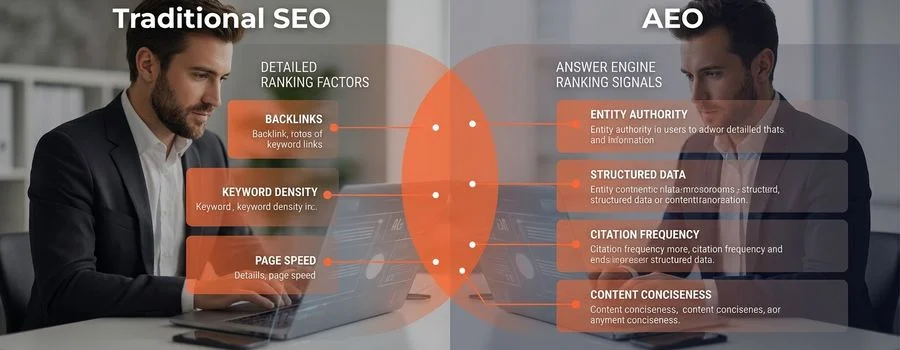
Traditional SEO and AEO share common foundations — quality content, technical excellence, and user experience — but they diverge in critical ways. SEO targets search engine crawlers and ranking algorithms. AEO targets natural language processing (NLP) systems and retrieval-augmented generation (RAG) pipelines.
Traditional SEO
- - Optimises for keyword rankings
- - Focuses on click-through rates
- - Targets Google, Bing SERPs
- - Measured by position and traffic
Answer Engine Optimization
- + Optimises for direct answers
- + Focuses on citation authority
- + Targets ChatGPT, Perplexity, AI Overviews
- + Measured by brand mentions and AI visibility
Why Your Business Needs AEO Now
The shift towards AI-powered search is accelerating faster than most businesses realise. According to industry research, over 30% of search queries now trigger AI-generated responses in Google's search results. ChatGPT has surpassed 200 million weekly active users. Perplexity processes millions of queries daily. These platforms are not replacing traditional search; they are becoming the primary interface for information discovery.
For Malaysian businesses, this shift presents both a threat and an opportunity. If your competitors optimise for AI visibility and you do not, they will capture the growing segment of users who rely on AI assistants for purchasing decisions, service recommendations, and business research. Conversely, early adoption of AEO gives you a significant first-mover advantage in your market.
At Adam SEO, we have observed that businesses implementing AEO strategies alongside traditional SEO see a compounding effect: stronger overall domain authority, higher engagement metrics, and increased brand trust — all of which feed back into better traditional search rankings as well.
Practical AEO Implementation Steps
Implementing AEO is not about abandoning your existing SEO work. It is about augmenting it with techniques that make your content machine-readable and authoritative for AI systems. Here are the key implementation steps we recommend:
1. Implement Comprehensive Schema Markup
Deploy structured data (JSON-LD) across your site: LocalBusiness, FAQPage, HowTo, Product, and Review schemas. AI systems heavily rely on structured data to understand and extract your content accurately.
2. Create Question-Answer Content Clusters
Structure your content around specific questions your audience asks. Use clear headings, concise answers in the first paragraph, and detailed elaboration below. This mirrors how AI systems extract and present answers.
3. Build Entity Authority Across Platforms
Ensure your brand has consistent, detailed profiles on Wikipedia, Wikidata, Google Knowledge Panel, industry directories, and authoritative publications. AI models learn entity associations from these cross-platform signals.
4. Optimise for Conversational Queries
AI search users ask questions naturally, not with keywords. Optimise your content for "who," "what," "how," and "why" queries. Include direct, factual statements that AI systems can confidently cite.
5. Monitor AI Mentions and Iterate
Regularly test how AI platforms respond to queries about your brand, services, and industry. Track whether your content is cited, how accurately it is represented, and adjust your strategy based on findings.

Frequently Asked Questions About AEO
Ready to Optimise for AI Search?
Let us audit your brand's AI visibility and build a strategy that positions you as the definitive answer.
Get My Free AEO Audit